
MECE = Mutually Exclusive Collectively Exhaustive
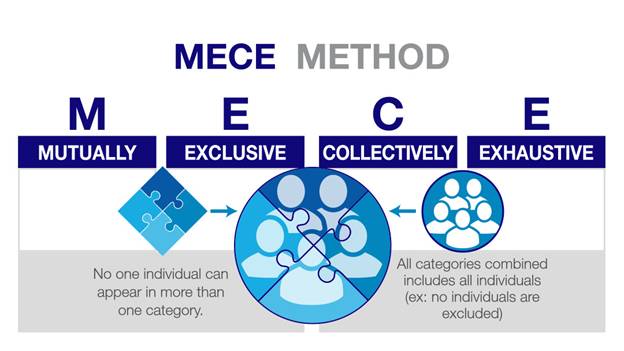
MECE stands for Mutually Exclusive Collectively Exhaustive. The MECE Principle is a framework used by management consulting firms to group data into categories that following a two specific rules. This categorization makes it easier to analyze and derive useful conclusions. The two data categorization rules of MECE are: Mutually Exclusive – An item or data record can only be in one category at a time and Collectively Exhaustive – All items or data records must be included in one category (e.g., your categorization structure can not exclude an item or data record)
To put it in “plain English,” a data set (such as customer data) is categorized in a MECE way when a record only appears in one category and all categories combined include all records of the data set.
The “Mutually Exclusive” part represents the idea that a single record can not appear in two categories (e.g., your height can’t be greater than 150 cm and less than 150 cm at the same time).
The “Collectively Exhaustive” means the categories used is completely exhaustive — meaning you didn’t forget a category (e.g., your height categorization structure includes both the shortest and the tallest person in the data set). MECE is much easier to understand via an example.
MECE Segmentation and Planning
MECE segmentation can be applied to any type of business or personal concern. It has clear practical advantages that help you to think analytically about the problem at hand.
Some examples of mutually exclusive collectively exhaustive segmentation include grouping customers by:
- Defined age brackets where there is no category overlap
- Country of Birth, assuming no geographical overlap
- Highest level of education obtained
- Defined revenue brackets
- Number of employee brackets

MECE Segmentation Example: Age Brackets
You might have a customer list segmented according to the following age brackets:
- Age 0-15
- Age 16-30
- Age 31-45
- Age 46-60
- Age 61-75
- Age 76+
With these categories, you have covered all possible ages of customers, and no individual can appear in more than one category, no matter when the analysis is performed. Notice that about 15 years are represented in each category, making them easily comparable.
Depending on the specific characteristics of your customers, you may be able to use a smaller number of categories that cover a broader range of ages. Some management consultants prefer this approach since it’s easier to manage fewer categories. But, having more categories helps ensure that the underlying similarities between the categories are clear.
Choosing Exhaustive Categories for MECE Segmentation
Consultants planning to use the MECE principle to their advantage must think through the categories carefully and challenge their initial response. Until you have practice with MECE thinking, it is common for the first categories you develop to need reworking.
Making the MECE Principle Work in Practice
There are some best practices that can make MECE easier to use. It’s important to understand each of these points before using MECE in your case interview with McKinsey or other top consulting firms.
There are five principles:
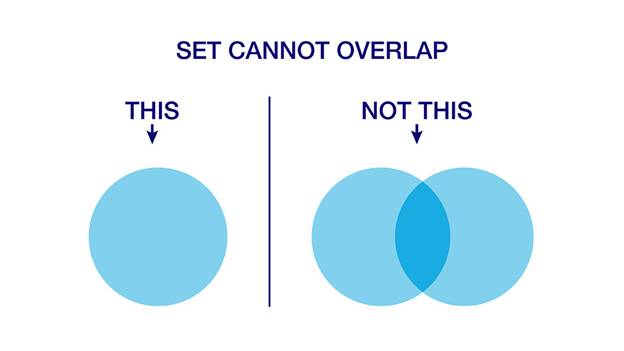
- The Small Elements of a Set Cannot Overlap
If items appear in multiple categories, the framework will not work correctly. Take time to think of any atypical situations that may put a person in more than one category.
In the age bracket example, it would be easy to accidentally create a non-MECE framework with just one year of overlap in your age brackets. In many situations, an overlap is caused by a simple typing error or oversight, so always double-check your materials.
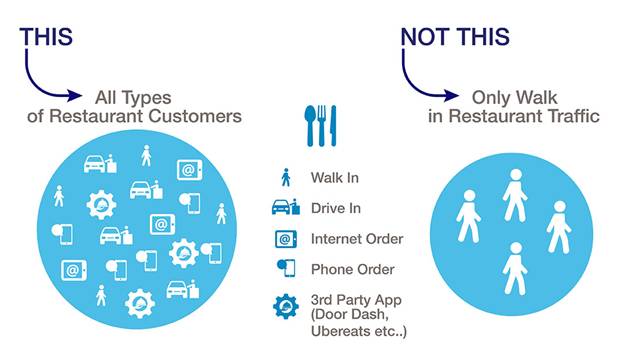
- The Sum of Parts Must Equal the Whole Group
For a framework to be collectively exhaustive, it must represent the whole group. This may require you to consider a typical customer use cases. For example, a restaurant might have walk-in, online, and drive-through customers. They may also have customers who order through third-party apps like Uber Eats or Door Dash. These customers must also be represented.
- Small Elements Must Parallel One Another
Categories in MECE classification should be directly comparable whenever possible. You would not want to compare the customers in the Boston metropolitan area with those in the whole state of Wyoming, even if the number of customers in each category is approximately the same.

- You Should Always Leverage the Magic of Three
The “Rule of Three” describes the fact that sets of three items tend to be memorable and intuitive. Although this is not an absolute requirement of MECE, it is easiest for people to remember sets containing four items or fewer. This will make the framework easier to understand.
- Look Out for Logical Errors and Inconsistencies
MECE is a potent tool, but it is not the only tool. It doesn’t protect you from all possible oversights or fallacies that you might come across. Always examine your assumptions closely, even if your MECE framework feels like it’s perfect.
The Shortcomings of Non-MECE Segmentation
Decision-makers in any job often make the mistake of using non-MECE grouping structures, particularly when thinking about their clients and customers. This leads to duplication of labor and makes it less likely that data collected will be relevant.
Non-MECE segmentation may seem intuitive at first. The data collected may be useful in other contexts, but it won’t solve your problem. If you get stuck on this data, it can lead to incorrect patterns of thinking that don’t address the strategic issues.
Some examples of non-MECE segmentation include listing customers according to:
- Hobbies and interests
- The colleges they graduated from
Non-MECE Example: Hobbies
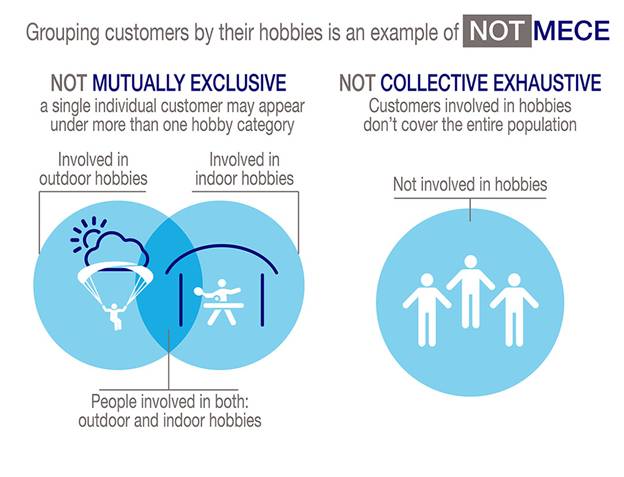
Why do these examples fall short? Let’s use the list of people separated by their hobbies as an example. A business might attempt to categorize their customers as involved in indoor hobbies or outdoor hobbies. Initially, this seems to have some logic to it. Looking closer, however, it also has clear drawbacks:
- It is not mutually exclusive since individuals may be involved in both types of hobbies.
- It is not collectively exhaustive since it does not address those not involved in hobbies.
MECE in Management Consulting Example:
The MECE principle is a foundational part of thinking through problems at management consulting firms. As a candidate, you will hear about it consistently throughout the recruiting process and will have to apply it in many scenarios. Luckily, these scenarios tend to mimic real-life situations closely.
During case interviews, you’ll often find yourself facing situations where you have very little data to act on. In these moments, recruiters are testing the limits of your ability to understand the situation and work through it in a fast-paced, uncertain environment– just as you will with your future clients.
The Profitability Framework
The most common example of MECE thinking-in-action is known as the profitability framework.

Using predefined frameworks in your case interviews can be problematic. They often fall short and fail to grasp the nuances of a real-world situation. However, the profitability framework is different. It is an efficient, precise approach utilized daily to decipher the root of a profitability problem. Revenues and costs are the key factors to be aware of.
Every step of the profitability framework is based on MECE thinking:
- First, profits are broken down into revenues and costs.
- Then, revenues are broken down into volume and price per unit (PPU).
- Costs are broken down into fixed costs and variable costs.
- Variable costs can be further broken down into volume and cost per unit.
This is the beginning of our issue tree. Each individual item is defined and kept separate from the rest. Then, operations can be performed on each, individually. In this case, the “operation” involves questioning items to try to find the source of the decline in profit.
The profitability framework, in particular, is helpful because it demonstrates how multiple data sets within your MECE analysis can be applied to a problem.
Within the profitability framework, looking at year over year volume and price per unit may help you determine if revenue declined over a certain period. While this is vital information, it doesn’t provide you with the complete picture. Costs could have increased over the same period of time, adding factors that you need to take into account.
MECE allows you to perform multiple analyses while keeping each analysis separate. This prevents mistakes that might be caused by incorrectly assuming there is a relationship where there isn’t one. In the end, you will have a full understanding of each individual piece of the problem. These all come together to form a bigger picture that will help you reach your conclusion.
How to Use MECE in a Case Interview
Case interviews are typically structured around a hypothetical problem that the interviewer will ask you how to solve. Frameworks are a good place to start in these situations but may not always apply.
Sometimes I start with a business situation framework, but then have to switch to a supply/demand framework. Other times, I’ll start with a standard framework, and then have to make up a new one on the fly.
In these situations, remember that your priority is to give a high-level answer that is organized in a way that is easy to follow way. If you panic and just start listing off half-developed ideas with no follow-up information, your interviewer will get lost.
This is where the MECE principle comes into play. MECE will help you focus on major categories and develop ideas from the top down. It essentially will give the interviewer an overview of your potential solutions.
Let’s say that the interviewer asks you, “How can this company grow?”
Here are some possible ways to organize your answer to that question:
- Products/Services – Existing vs. New
- Customers – Existing vs. New
- Distribution Channels – Existing vs. New
From here, you can narrow down your ideas based on the interviewer’s follow-up questions/information. There may still be overlap in these primary areas, but sometimes you won’t be able to get around it.
You may find that your interviewer is speaking in vague terms or unwilling to help you unpack a question. This could be because the interviewer doesn’t want to give away the answers they are looking for by giving examples. Restructure the question you ask or confirm that you understand correctly before attempting to answer the question.
Also, the interviewer may not have the expertise in some areas to answer your questions or give you more information.
While consultants like to have a clean MECE framework, sometimes being MECE-enough is all you can come up with on the spot. All you can do is narrow it down as far as possible. Before you resign to the MECE-enough approach, make sure you’ve explored all your other options.
In terms of practicing your MECE skills, use the framework in everyday life as much as possible. It may sound absurd for everyday life, but it will help you think like a consultant.
Maybe your spouse asks you “Where should we go to dinner tonight?”
You break down your options like this:
- Restaurants you both have been to
- Restaurants one of you have been to
- Restaurants none of you have been to
You may not want to use this approach out loud in a social setting — just think that way in your head. Eventually, it will become second nature to solve problems this way.
Conclusion
The Mutually Exclusive Collectively Exhaustive (MECE) principle will make you a better decision-maker and problem-solver. It helps you see the situation more clearly and reach conclusions that are really going to help your business. Do you see how the next time you are faced with a complex issue, using the MECE framework will assist you with working out the possible causes and lead you to the best solution? How would you use the mutually exclusive collectively exhaustive principle to solve a business or personal problem you are currently faced with?
10 thoughts on “MECE Framework / Principle – What does it mean? Why do consultants find it useful?”
Pingback: The plural of anecdote isn’t Data: Structuring the search for your Data Story - Story Rules
Pingback: How to Criticize (and Have Them Thank You) | Caseinterview
Pingback: A Guide for Case Study Interview Presentations for Beginners
Pingback: Nervousness vs. Confidence in Case Interviews | Caseinterview
Pingback: Tips for Practicing without Live Practice | Caseinterview
Pingback: Fundamentally special: why research is an indispensable specialisation in UX – Modernuance
Hiee,
Actually I am also not getting a point how MECE works to categories and build a frame work kindly explain.
Your profitability example is not really mutually exclusive: # Units sold is shared between the revenue and cost side of the tree. This article fails to clarify or illustrate the benefits of mutually exclusive versus overlapping categories, and most real data is network (overlapping) rather than tree (mutually exclusive) structured.
Hello,
Regarding mutually exclusion, you give the example that segmenting people according to indoor and outdoor hobbies is not mutually exclusive. But how is the mutually exclusive problem of this segment different than segmenting based on restaurant customer types — Walk in, Drive in, Internet Order, Phone Order, or 3rd party app? Just as a person can be involved in both in-door and out-door hobbies, a person can also be a walk-in, drive-in, or internet customer. It’s mainly a matter of context — when, where, and why for that particular event. And it applies to both examples.
So I’m confused. Please explain. Thank you.
Hi Mala – You wouldn’t categorize people based on walk-in, drive thru, phone order, or 3rd party app. However, you would categorize orders by walk-in, drive-thru, etc… Instead, you would categorize people by factors like age. Someone over 50 years old is not simultaneously under 50 years old too. -Victor