
Guide to the McKinsey PST — 2023 Update
Guide to the McKinsey PST 2023 Update
UPDATE as of the 2023 Recruiting Season: McKinsey is in the middle of transitioning from the Problem Solving Test (PST) to the McKinsey Problem Solving Game, which is formally known as the "McKinsey Solve Game", McKinsey's assessment game.
For McKinsey Problem Solving Test info, read below.
Get the guide directly to your email.
Complete the form below and get Part I and Part II of the Definitive Guide to the McKinsey PST directly to your email.
This form collects your name and email so that we can add you to our email list that delivers the free resources you are requesting. Check out our privacy policy for details on how we protect and manager your submitted data.
The McKinsey Problem Solving Test (also known as the McKinsey PST) is a math computation, data interpretation and logical thinking test used by McKinsey to determine which candidates are granted a first round case interview. In general, candidates whose resumes McKinsey deems acceptable are invited to take the test. Based on feedback from hundreds of test takers, you must pass the test in order to get the interview. There are few to no exceptions to this rule.
Why the McKinsey PST Exists
The reason McKinsey uses the test is because there are a certain set of numerical computation and logical thinking skills required to be successful in consulting. While standardized math tests like the quantitative sections of the SAT, GRE, or GMAT do test math computational skills, it is possible to get perfect scores on these math tests but fail on the job in consulting.
It’s my interpretation that McKinsey developed the McKinsey Test in order to test those skills that regular math tests do not adequately evaluate. In particular, these skills involve data interpretation and critical numerical reasoning.
Now when I hear the words “data interpretation” and “critical numerical reasoning”, it always reminds me of those college entrance exam tests that were challenging, seemingly arbitrary and pretty much not useful in the real world. But, it turns out these skills actually have a very practical purpose while working as a consultant.
These skills allow you to:
1) Read a graphical chart (or the data spreadsheet that was used to create the chart)
2) Grasp what the “data is conclusively telling you” and separate from what the “data is suggesting (but not definitively so)”
3) Write a 1 – 2 sentence “headline” at the top of a Powerpoint slide state a logically correct conclusion
In other words, you end up using these skills every single day as a consultant. And if you use these skills incorrectly, then either your manager or partner has to redo your work for you (which means at some point you will get fired) or the client notices the logical flaws in your work and it makes your firm, your partner and your manager look bad (and of course means that at some point you’re going to get fired).
Now you would think looking at a chart and writing a powerpoint headline is not a very difficult skill. I mean anyone can look at a chart and write a headline, but you would be surprised by how many people actually get the headline wrong. In other words, a LOT of aspiring consultants and even some first year consultants see that data and come to the WRONG conclusion.
From a McKinsey partner’s point of view, it’s a complete disaster if someone on your team lacks this skill… or even worse THINKS he has the skill, but actually doesn’t.
It is such a big deal that McKinsey has gone to extensive effort to create this test and have thousands of candidates around the world take this problem solving test. All of this effort is taken for the sole goal of hiring new consultants who can do 1) do math accurately, 2) do it quickly, and (most importantly) interpret data CORRECTLY.
In short, being able to solve problems logically is a BIG DEAL.
McKinsey PST Format
The computer-based test consists of approximately 26 questions and lasts 60 minutes. No business background is needed to take the test, but being familiar with a few commonly used business terms is useful (see the McKinsey PST Frequently Used Terms section of Part II of this Guide Below). You are permitted to use pen, pencil or paper. No calculators or computing devices are permitted.
Typically a graphical chart or table of numerical data is presented along with some descriptive text about a company or industry. 4 – 5 questions follow that refer to the chart. The two most problem question types are:
1) Math Word Problem – Given the data in Table X, calculate A, B or C.
A, B or C might be profit margins. It might be figuring out which company’s profits were larger two years ago. It might be calculating the difference in sales from today vs 2 years ago for two different companies – and figuring out which company had the bigger change.
In the US, we call these “word problems”. The purpose of these problems is to give you raw data and information conveyed in a text paragraph, and see if you can figure out the math equation needed to solve the problem. Often the actual math computation isn’t difficult (its just addition, subtraction, multiplication or division; often math problems are based on percentages – growth rate, cost expressed as a percentage of sales, or profits as a percentage of sales, sales of this year vs 3 years ago expressed as a percentage).
What makes the word problem difficult is a) Time, b) Time, c) Time.
Amongst those who pass the McKinsey Problem Solving Test, the consistent feedback was they finished with barely enough time. The most common reasons for making a mistake for a math word problem is misreading, misunderstanding, or misinterpreting the data presented or what the question was asking. The other big reason is computational error.
When I took my first McKinsey PST practice test, I actually missed several problems. To be fair, I had a newborn baby in the house and was sleeping 3 hours a night at the time, and I made a LOT of careless errors. My mistakes: I thought they were asking one thing, when they were really asking another. I rushed the computation, and made mistakes.
2) Data Interpretation – “Given X chart, which of the following conclusions are accurate:”
The other type of question isn’t computationally intensive, but rather tests your logic and critical reasoning skills. You will be asked to refer to a chart or data table (mini spreadsheet with numbers) and asked some variation of the question: Which conclusion is correct?
Variations of this question including presenting you with potential answers that are a) definitively correct, b) could be correct but you can’t be 100% sure, c) definitely wrong. The answers that are trickiest are ones that seem consistent with the data, but is NOT completely conclusive. In other words, you need to be able to look at the data and tell the difference between a factual conclusion vs. a hypothesis suggested (but NOT 100% proven) by the data
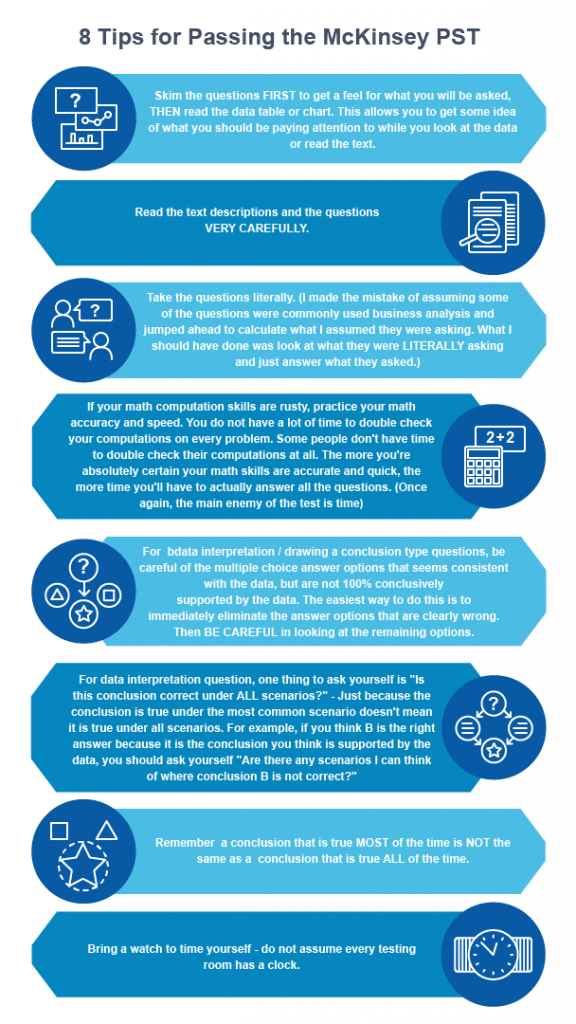
Skim the questions FIRST to get a feel for what you will be asked, THEN read the data table or chart. This allows you to get some idea of what you should be paying attention to while you look at the data or read the text.
- Read the text descriptions and the questions VERY CAREFULLY.
- Take the questions literally. (I made the mistake of assuming some of the questions were commonly used business analysis and jumped ahead to calculate what I assumed they were asking. What I should have done was look at what they were LITERALLY asking and just answer what they asked.)
- If your math computation skills are rusty, practice your math accuracy and speed. You do not have a lot of time to double check your computations on every problem. Some people don’t have time to double check their computations at all. The more you’re absolutely certain your math skills are accurate and quick, the more time you’ll have to actually answer all the questions. (Once again, the main enemy of the test is time)
- For data interpretation / drawing a conclusion type questions, be careful of the multiple choice answer options that seems consistent with the data, but are not 100% conclusively supported by the data. The easiest way to do this is to immediately eliminate the answer options that are clearly wrong. Then BE CAREFUL in looking at the remaining options.
- For data interpretation question, one thing to ask yourself is “Is this conclusion correct under ALL scenarios?” – Just because the conclusion is true under the most common scenario doesn’t mean it is true under all scenarios. For example, if you think B is the right answer because it is the conclusion you think is supported by the data, you should ask yourself “Are there any scenarios I can think of where conclusion B is not correct?”
- Remember a conclusion that is true MOST of the time is NOT the same as a conclusion that is true ALL of the time.
- Bring a watch to time yourself – do not assume every testing room has a clock.
McKinsey Problem Solving Test – 3 Ways to Prepare
The biggest challenge for developing your problem solving skills is there aren’t many McKinsey PST practice test that are at a difficult level equal to that of the actual McKinsey Problem Solving Test. For a full list of practice tests available online, fill out the McKinsey Practice Test List – Request Form below.
There are three approaches you can take to prepare for PST:
1) Practice Computations
2) Practice Data Interpretation
3) Take McKinsey PST Practice Tests
Below are tips and resources for each of the practice methods.
Practice Method #1: Practice Computations
The first method is to practice the speed and accuracy of your arithmetic. The McK PST is a TIMED test. This is not the kind of math test designed to test the entire population of people with a wide range of math skills. It is intended to identify only those who are very good at math, logical thinking, etc… If you are really good at math, you will finish the test BARELY.
So even if you have a PhD in Physics or Math (I’m being serious on this), it is VERY IMPORTANT you do math practice for case interviews. I get many, many emails from engineers who had 4.0 GPAs in school who did not pass the PST. Your math computation skills are a muscle. The more you use it, the stronger it gets. Keep in mind even if you calculate an integral effortlessly, it doesn’t mean you can’t make an error doing basic computations.
One resource I’d recommend to develop your computation accuracy and speed is www.CaseInterviewMath.com. This is a math practice tool that I developed for practicing: 1) arithmetic for speed and accuracy (both VERY important on the McKinsey PST) and 2) estimation math with large numbers (useful for solving some of the McKinsey PST word problems faster where precise math isn’t necessary to answer the question, just an estimate will suffice.)
This tool compares your math accuracy and speed to other CaseInterview.com members and to my own test results as benchmark. This will help give you an idea of how your math skills compare with others; and whether or not you need to improve your math speed and accuracy to be competitive, or if you current skills are sufficient.
In addition to practicing math computations, you want to practice and develop your data interpretation skills.
Practice Method #2: Practice Data Interpretation
For data interpretation, the practice questions that most closely resemble PST questions are practice test questions from certain sections of the GRE. In particular, I would recommend practice “word problems” and “data interpretation” type GRE questions.
Keep in mind the actual McKinsey Problem Solving Test questions are harder and more sophisticated than the word problems and data interpretation questions in GRE. Sometimes the questions are combined — word problem + data interpretation. Other times instead of presenting a straight forward problem, as you would see on the GRE, you’ll see a more elaborate scenario (or multi paragraph story with one or more charts) where you have to figure out what information is irrelevant to the specific question at hand.
Remember, each chart is referenced by 4 – 5 questions. So for any ONE question, most of the information presented is NOT relevant to THAT particular question.
But before you work your way up the elaborate questions, polishing your foundational skills in word problems and data interpretation is a good idea.
Data Interpretation & Word Problem Practice Resources:
- Kaplan GRE Exam Math Workbook – Chapter’s on Arithmetic Review (if you’re really rusty on math), Word Problem Practice and Data Interpretation Practice
- Nova’s GRE Math Prep Course – Sections on Percent’s, Graphs, Word Problems and If you’re really rusty on math: Averages, Ratio & Proportions
- Cliff Notes Math Review for Standardized Tests – Word Problems Review
Online Practice Resources:
Because GRE problems are much easier than the PST problems, you need to balance the nearly unlimited practice questions (that are too easy) available for the GRE vs. the much smaller pool of practice problems for the PST. In addition, there are only a few PST practice tests available online for free. The other practice tests available (including the ones I offer) do have a fee.
Additional Note: As of June 5, 2012, the GMAT is being revised to include a section on “Integrated Reasoning”. From my assessment, this section of the GMAT has many similarities to the McK PST. If anyone has any experience with this version of the GMAT or as the test prep guides are updated to reflect this new section of the GMAT, please post your experiences below and I will incorporate the feedback into a revision of this guide.
Practice Method #3: Take McKinsey PST Practice Tests
The following are links to a few McKinsey PST Practice Tests.
Links to Free Problem Solving Test Samples:
- McKinsey Problem Solving Test – Sample Test Question on Data Sufficiency (from this website)
- McKinsey Problem Solving Test – Example Test Question on Data Sufficiency – Answer Guide (from this website)
- McKinsey Problem Solving Test 1 (from McKinsey Website)
- McKinsey Problem Solving Test 2 (from McKinsey Website)
- McKinsey Problem Solving Test 3 (from McKinsey Website)
- McKinsey Problem Solving Test Coaching Guide (from McKinsey Website)
Note: The consensus feedback from reader Field Reports is the actual McKinsey Test has a lot more reading than the samples posted above. My takeaway from this is that its important to read the questions FIRST, then read the text and charts. Keep in mind you are not reading a magazine article or a business school case. Your only mission is to answer the questions asked and to move on… QUICKLY.
With that in mind, I recommend reading with a PURPOSE in mind, as opposed to just for general knowledge. In other words, KNOW what you’re looking for BEFORE you read. Then read carefully while hunting for the data you KNOW you will need to answer the questions.l
Get Part II of the Definitive Guide to the McKinsey Problem Solving Test
In Part II of the Definitive Guide to the McKinsey Problem Solving Test, you’ll receive via email:
- A glossary of commonly used business terms and their mathematical definitions
- An expanded list of high quality, practice tests for the McKinsey PST
- Tips on the McKinsey PST and Case Interviews
To receive these free resources, fill out the form below.
(Note – you will be returned to this spot after filling out the form)
The Definitive Guide Part I – Continued
Field Reports from Previous Test Takers
The following comments are from one of my newsletter readers who took and passed the actual McKinsey Problem Solving Test. (By the way, just click the following link to receive my case interview preparation tips newsletter)
Field Report #1
The actual test does not match the practice test in terms of level of difficulty, but it cannot be said that it is harder.
Some questions are harder, some are easier than those given in the practice test. But the practice test gives you a feel of the type of questions and timing.
I did a few things in particular to prepare that I thought would be useful, however they were more about the attitude than actual preparations for the test:
In terms of preparations, I only solved the practice test and then compared my answers to the correct ones. Then I worked out the wrong answers slowly to realize where did I go wrong.
When it comes to the attitude, it is important to go to the test with a positive attitude but with the expectation that very few are those who actually make it.
Going with a “Why-not; let’s take a shot” attitude will alleviate a good portion of the stress associated with the tight timing and will allow the candidate to think clearly.
Now here are some additional insights about the PST:
For business or economics students, just practice the sample and mind the time, you know the rest. (This is my own experience as a business graduate)
For non-business students, brush up on few quantitative business concepts before going to the test, it is said that it does not require a business knowledge, but definitely some business sense and acumen.
Stress will definitely play against you, RELAX the test can be completed in the allotted time, don’t worry about it.You will be marking the 26th answer by the end of the last minute though.
Make sure you complete all questions, there are no penalties; but this we know. What we don’t know is, even when you are taking a question as a guess, the test is tailored such as it will allow you to take an informed guess which is correct; so use elimination and educated guesses to your advantage.
When it comes to the attitude:
Very few people get into McKinsey, put this information into perspective and go to the test in a ‘Game’ frame of mind, enjoy it; it is nice and stimulating.
Relax, breathe before starting the test and remember if you made it so far and your consulting resume caught McKinsey’s accurate eye, it means you mostly have what it takes to pass.
Do not stress about the outcome of the test once you leave the room. Mckinsey will get back to you shortly; they have the best recruitment system in the world and they do not make people wait, I know people who knew the outcome as early as 24 hours after the test.
A great thing that is a MUST-KNOW about McKinsey, they do not select the top x% performers. They have a cut-off score, if you pass it, you’re in for the interview process; you’re not competing against anyone, you’re only invited to stretch your own potential.
One last note I would like to add, you will get out of the McKinsey process feeling great, whatever the outcome is. These people are amazing, this company is extremely professional; and they make you feel appreciated and respected at every stage of the recruitment process, whether you make it or not. So my point: get the best out of it for yourself.
Field Report #2: (From a Reader)
Note: Concerning the PST test, I found that the best way to get the answer for a question is by applying a similar analysis to a case interview. That is, when asked about something, the best way is to actually think of a hypothesis and what kind of data is needed to give the answer. And then look for the data in the text. I found that pretty useful. I felt like sharing this as a tip.
****
Finally, if you haven’t already requested my guide to the McKinsey PST, you can do so by filling out the form below.
Get the guide directly to your email.
Complete the form below and get Part I and Part II of the Definitive Guide to the McKinsey PST directly to your email.
This form collects your name and email so that we can add you to our email list that delivers the free resources you are requesting. Check out our privacy policy for details on how we protect and manager your submitted data.